At 52, I Looked Tired Even When I Wasn't Tired. Four Months Later My Sister Said, "You Look Rested."
 BEFORE
 AFTER
AFTER
I Know Exactly Why You're Reading This
Something brought you to this page.
Maybe it was a photo someone else took of you. Maybe it was a work call where you caught your own face in the corner of the screen and didn't quite recognize the woman looking back.
Or maybe it was simpler than that. Maybe you put your foundation on this morning and watched it settle into the lines around your eyes instead of smoothing them out.
I know exactly what that feels like.
You've tried things. Of course you have. A retinol that made your skin flake. A serum that cost more than a week of groceries. Something a friend swore by that did nothing for you at all.
And then you stopped. Not dramatically. You just quietly stopped believing any of it was going to work.
I stopped too.
I was wrong about that.
At 52, I Had Quietly Given Up On My Face
I was getting ready for my son's college graduation.
I was under those bright bathroom lights doing my makeup, and I kept looking at the crepiness around my eyes and the dullness in my cheeks. I'd put on foundation and it would just sit in the fine lines instead of smoothing out.
I remember thinking, I look tired even when I'm not tired.

Then my sister sent me a group photo from that graduation weekend.
I zoomed in on my own face before I even looked at anyone else.
That's when it really hit me. It wasn't dramatic. Nobody said anything. It was just me looking at a photo of myself and not liking what I saw.
I Started Turning My Camera Off In Meetings
The photo was the moment I noticed it. But it wasn't really where it bothered me.
Work was. I'm in meetings a lot, and I started catching my own reflection in the laptop camera during video calls and thinking, I look like I didn't sleep. Even on days I did.
That bothered me more than any single photograph, because it was every day. Not a one-time thing.
I started turning my camera off more than I used to. Or angling it so the lighting was more forgiving.
And I stopped going anywhere without at least some concealer. Even to the grocery store, which I never used to think twice about.
If I had to date when it started, somewhere around 48 or 49. It wasn't gradual the way I expected. It felt more like I woke up one year and my skin looked different than it had the year before. It happened faster than I thought it would.
My Dermatologist Told Me To Have Realistic Expectations
I'd already asked a professional about it.
I'd seen my dermatologist a few months before that, mostly for a mole check, and I mentioned the fine lines while I was there.
"Is there anything over the counter that actually does something?"
"Retinoids are the gold standard. Past that you're looking at microneedling or laser."
"And creams?"
"Most of them are marginal. I'd just have realistic expectations."
She wasn't dismissive. She was being straight with me.
But it stuck. Because what I heard was that nothing I bought myself was going to do much.
Three Products. Two Hundred And Seventy Dollars. Nothing.
By then I'd already tried three things on my own.
A whole drugstore phase first. Neutrogena's retinol line, I want to say around $25.
My skin flaked and went red around my nose within a week. So I backed off to twice a week, and then honestly I just got scared of it.
Which, looking back, is the part nobody warns you about. I didn't decide it wasn't working. I decided I couldn't keep doing it.
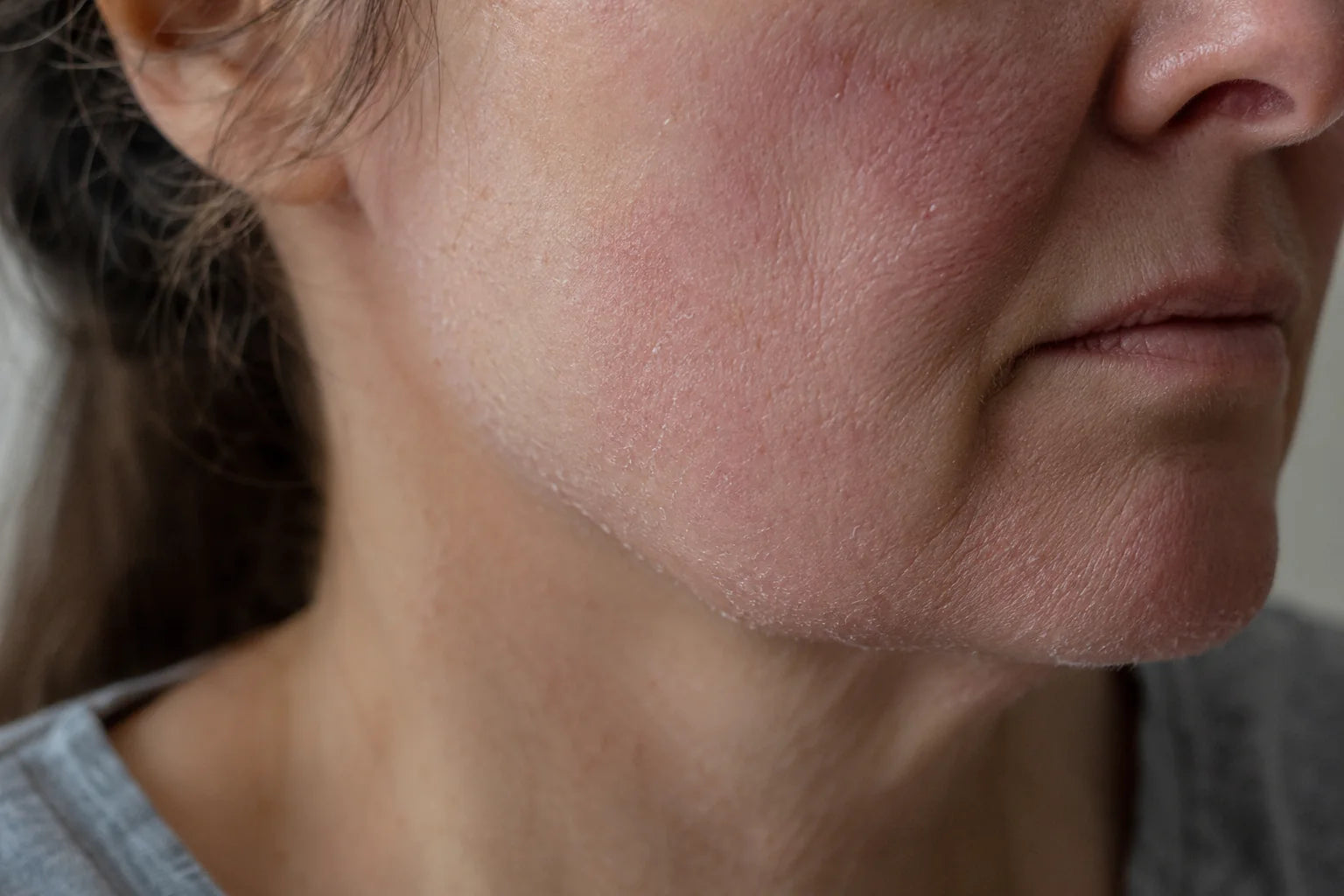
Then I got more serious and bought a vitamin C serum a friend recommended. That one was closer to $65.
It did nothing that I could tell. Maybe a little brightness. Nothing I'd swear to.
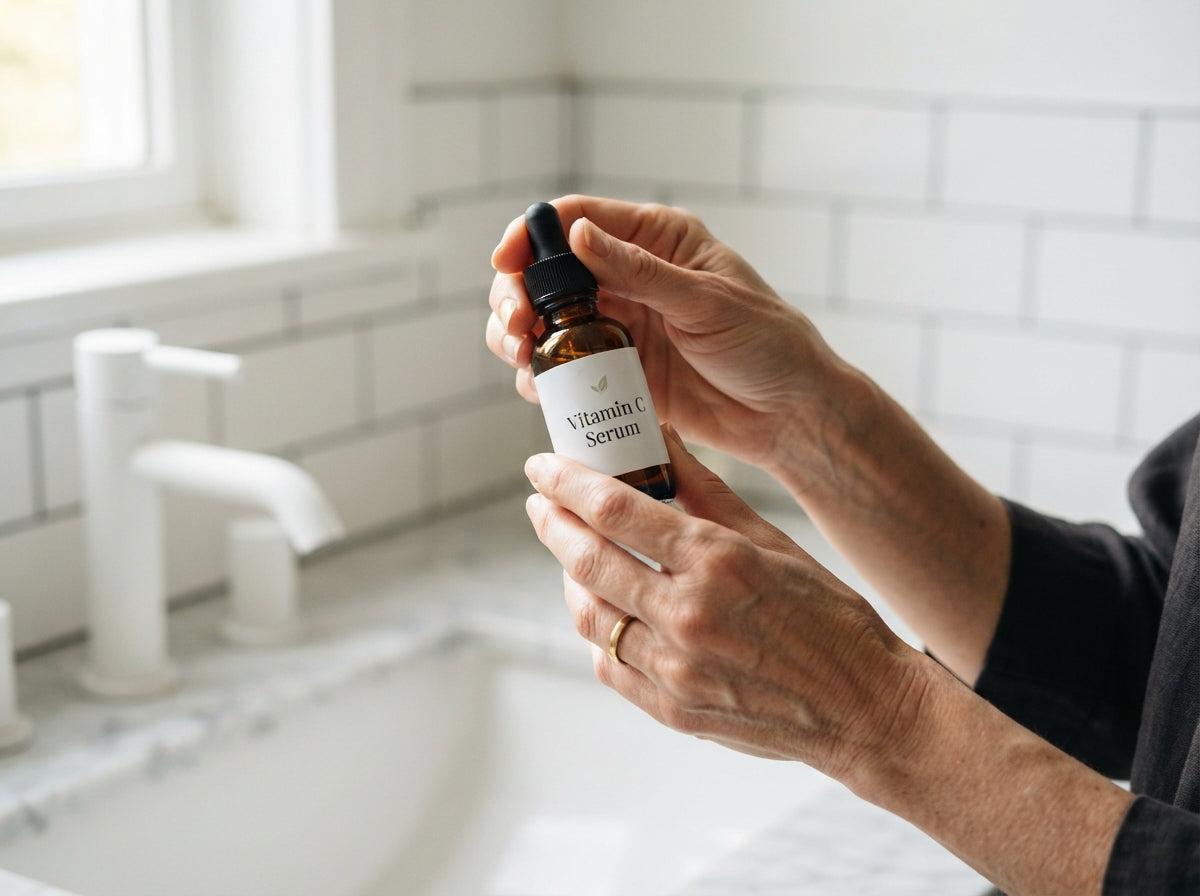
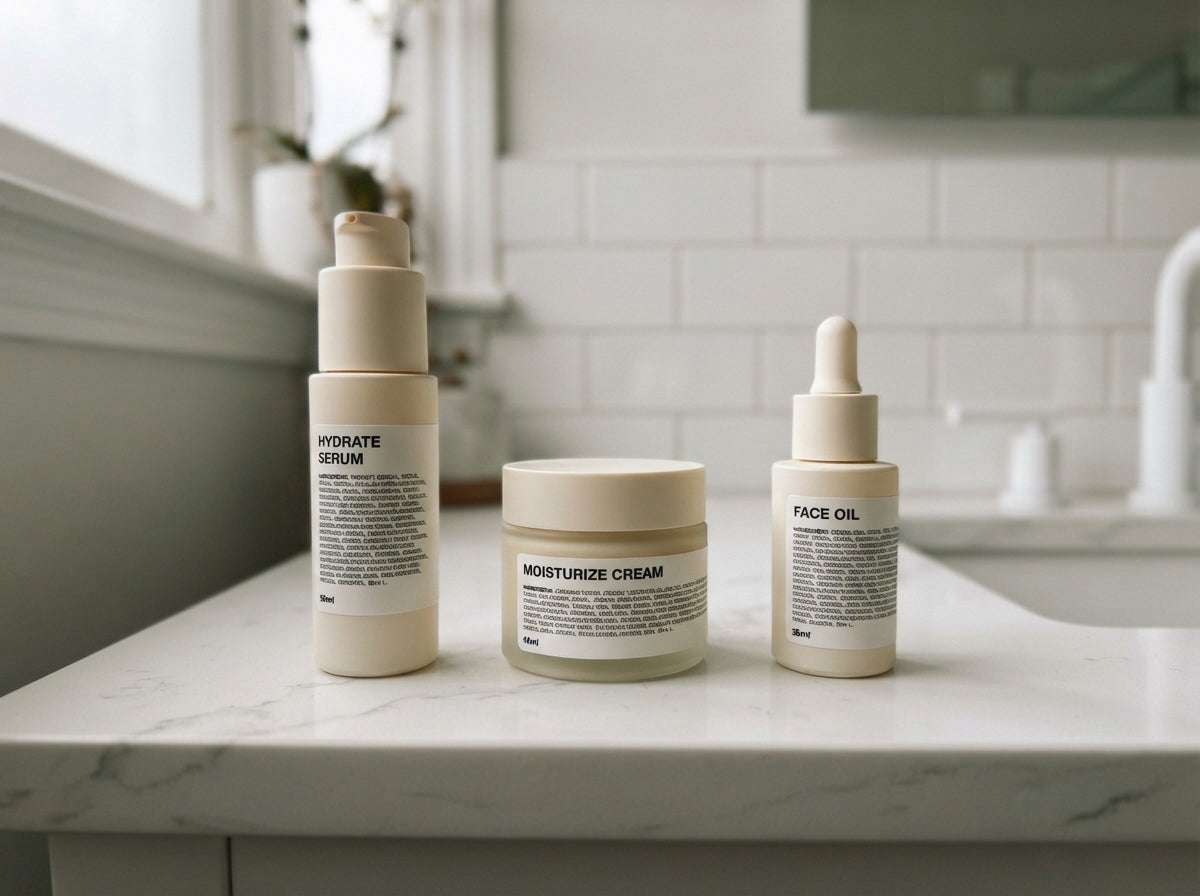
And then I splurged once on a department store anti-aging set. The kind with three little bottles. Almost $180 for maybe six weeks of product.
It felt lovely going on. It smelled wonderful. Three months later I couldn't tell you it changed anything.
I just stopped buying it when it ran out.
With the retinol I blamed myself. Like I was doing it wrong, or my skin was too sensitive for real skincare. Denise M., 52
That's the honest part I don't think women say out loud enough.
With the retinol I blamed myself. With the $180 set I blamed the product, or maybe myself again for expecting three little serums to actually do something.
Either way I'd quietly decided this was just what my face looked like now.
Then One Sentence Explained Why None Of It Had Worked
What changed things was an ad I almost scrolled past.
Late at night, on Instagram. It was talking about copper peptides, which I had genuinely never heard of.
And it wasn't the usual reverse-your-age-in-seven-days language. It actually explained a little about what the ingredient does.
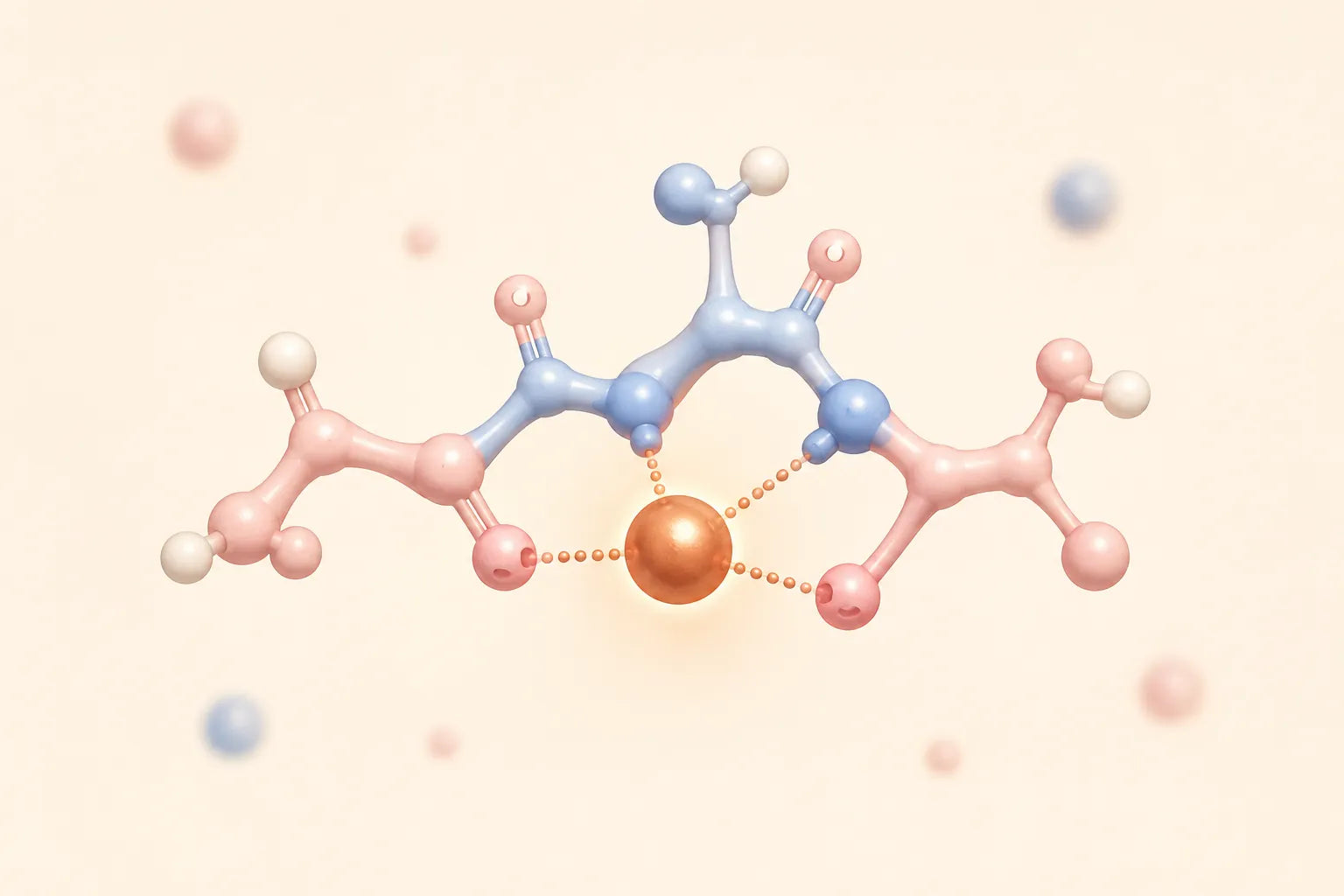
Here is what I thought I knew, and I think most women my age believe the same thing.
Your skin ages because you are losing collagen. So you put collagen back. That is what every ad I had ever seen told me. It is essentially what the $180 set was selling.
The losing part is true. Collagen does decline. Nobody disputes that.
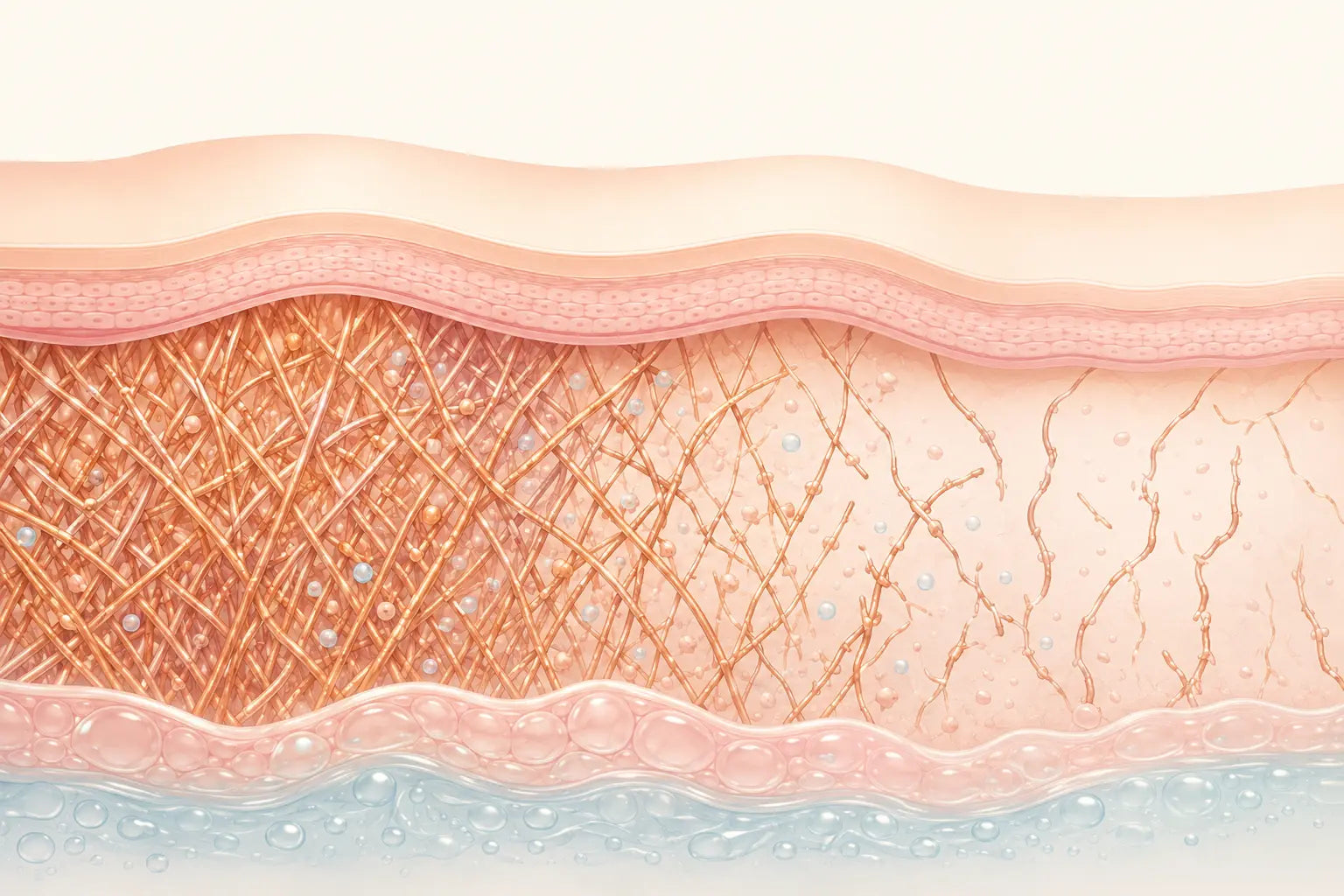
But collagen is the building material. Something still has to tell your skin to use it.
And if that instruction is not being sent, putting more material on the surface does not accomplish very much.
Which finally explained something the expensive set never did. Why I could keep layering things on my face and not really see anything change.
I'd been buying bricks for fifteen years. Nobody was telling the crew to show up.
I Didn't Believe It. I Ordered It Anyway.
The price stopped me for about two weeks. $37 a month felt like a real commitment after the vitamin C serum did nothing.
And I'd never heard of copper peptides, so part of me thought, is this just a trendy ingredient with a new name slapped on it?
So I looked it up myself, outside the ad.
It turns out GHK-Cu occurs naturally in human blood plasma, and it was first identified back in 1973. It isn't new and it isn't a marketing invention. The published research is laboratory work on the ingredient rather than trials of a finished cream, and I want to be accurate about that. But it had been studied for decades, which is more than I could say for the $180 set.
GHK-Cu is what they call a signal molecule. Published laboratory research has looked at its role in skin remodeling, including work on collagen.
The amount your body carries declines substantially as you get older, which is the part I keep thinking about.
I want to be careful here, because I am not a scientist and I do not want to oversell this. That research is laboratory work on the ingredient. It is not a clinical trial of this finished cream. But it has been investigated for fifty years, and in a category where most ingredients show up with a press release and a stock photo, that struck me as unusual.
There was one more thing I only understood later, once I had been using it a while.
Retinoids work by pushing your skin. Controlled irritation, basically. That is the mechanism, and it is why the peeling happens.
This does not work that way. It is a molecule my body already makes, so there was no adjustment period to survive.
For me that was the entire difference. Because the adjustment period is exactly where I quit the last time.
The other thing was the 60-day guarantee.
I told myself if it does nothing, I'm not out the money permanently.
That took the risk off the table for me.
What Happened Next Is The Only Reason I'm Writing This
The first night. It went on lighter than I expected. A thin lotion, not a thick cream. Absorbed in about thirty seconds. No film, no sting.
I looked up at the mirror. Same tired face. Same lines. Same hollow under my eyes.
"Don't," I said out loud, to my own reflection. "You've been here before."
I turned off the light and went to bed.
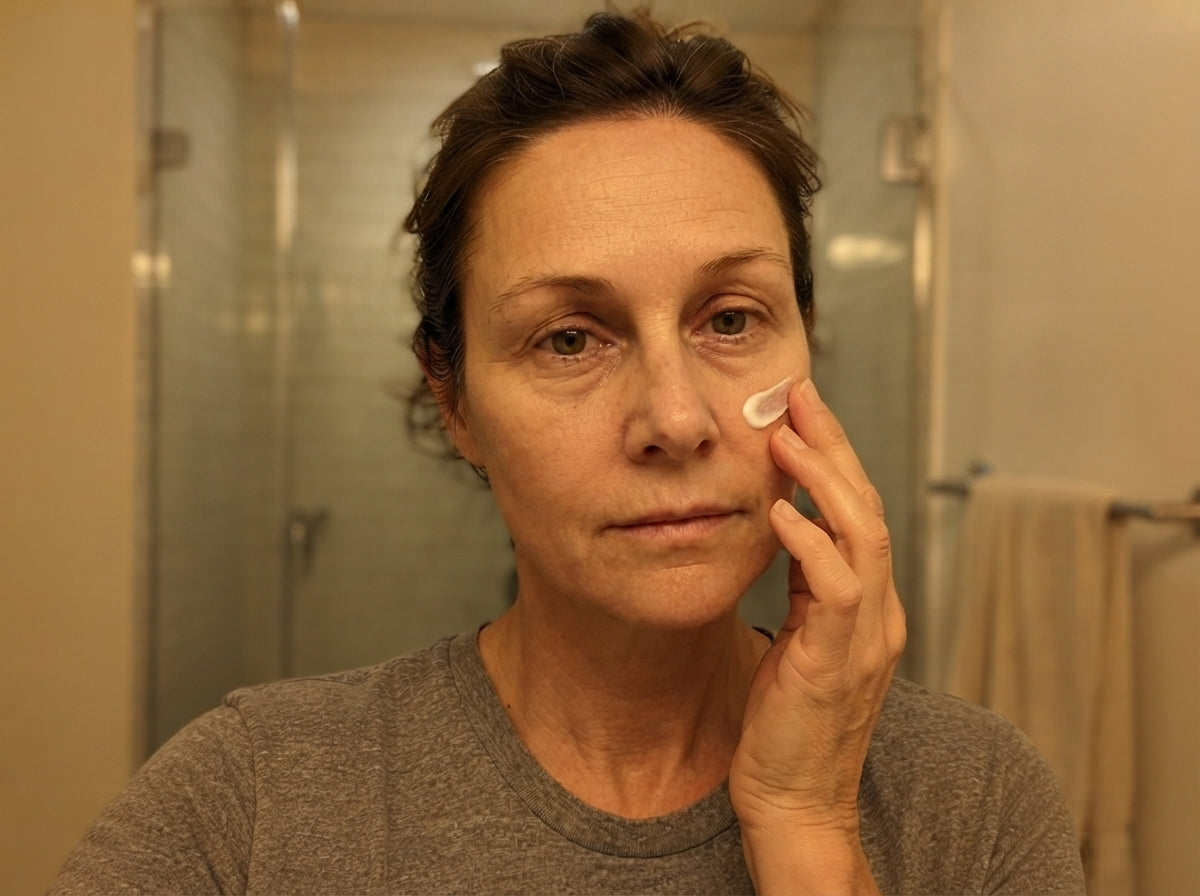
Week one. My skin stopped feeling tight after I washed it.
I hadn't even known that was a problem until it stopped happening. No flaking. No redness. Nothing like what the retinol had done to me.
That's just moisture, I told myself. Moisture isn't the same as change.
"Don't," I said out loud, to my own reflection. "You've been here before." Denise M., 52
Week five. It was the makeup.
Foundation was going on smoother. It wasn't sinking into those fine lines by my eyes the way it had for two years.
That is a very specific thing I check every single morning. So it stood out.
I stood at the mirror longer than I needed to. Not out of habit. Out of curiosity.
Week six. My husband noticed, which almost never happens.
"Did you change your makeup?"
"No."
"Something's different."
"Different how?"
"I don't know. You just look less… tired."
I didn't tell him yet. I wasn't sure enough to say it out loud.
Week eight. My coworker Angela stopped me in the hallway.
"Okay, what foundation are you wearing?"
"I'm not wearing any."
"Denise."
"I'm not. I came straight from the gym."
She looked at me for a second too long and walked off.
That one I thought about all day.
Month three. It started happening with people who had no reason to say anything.
A woman behind me at the pharmacy asked what I used. Not as small talk — she actually wanted the name.
The girl at the front desk of my gym guessed my age eight years low, out loud, in front of other people.
And a woman at church touched my arm after the service and said, "Whatever you're doing, keep doing it."
Month three, later. My sister — the same one who sent me that graduation photo — said it before I'd told her anything at all.
"You look rested."
She has never said that to me. Not once in fifty-two years.
"I'm not, particularly."
"Well, something's different. You're less crepey around your eyes."
Her word. Not mine.
I told her what I was using. She ordered a bottle that night.
Month four. Back in the same office. Same paper on the same table. Same doctor who had told me to have realistic expectations.
She was looking at my chart. Then she looked up at me. Then back at the chart.
"Your texture has improved. Your elasticity is better than my notes from last year."
"Is that unusual?"
"At fifty-two, going the other direction? Yes. What are you doing?"
"A copper peptide cream."
She wrote it down.
"Last time I was in here, you told me to have realistic expectations."
She didn't look up from the notepad.
"I did."
"And?"
"And I'd have said the same thing to anyone. I was wrong about you."
Same office. Same chair. Same fluorescent lights.
Different skin. Different woman.
And it started with one bottle and about thirty seconds, twice a day.
"At fifty-two, going the other direction? Yes. What are you doing?" Denise M., 52
60-day money-back guarantee
My Routine Got Shorter, Not Longer
I wash my face with a gentle cleanser. Nothing fancy.
Then the cream, while my skin is still a little damp. I wait maybe two minutes, then sunscreen, then makeup if I'm going somewhere.
That's it. Maybe three minutes, cleanser to cream. I do it while I'm still half asleep. It is not a production.
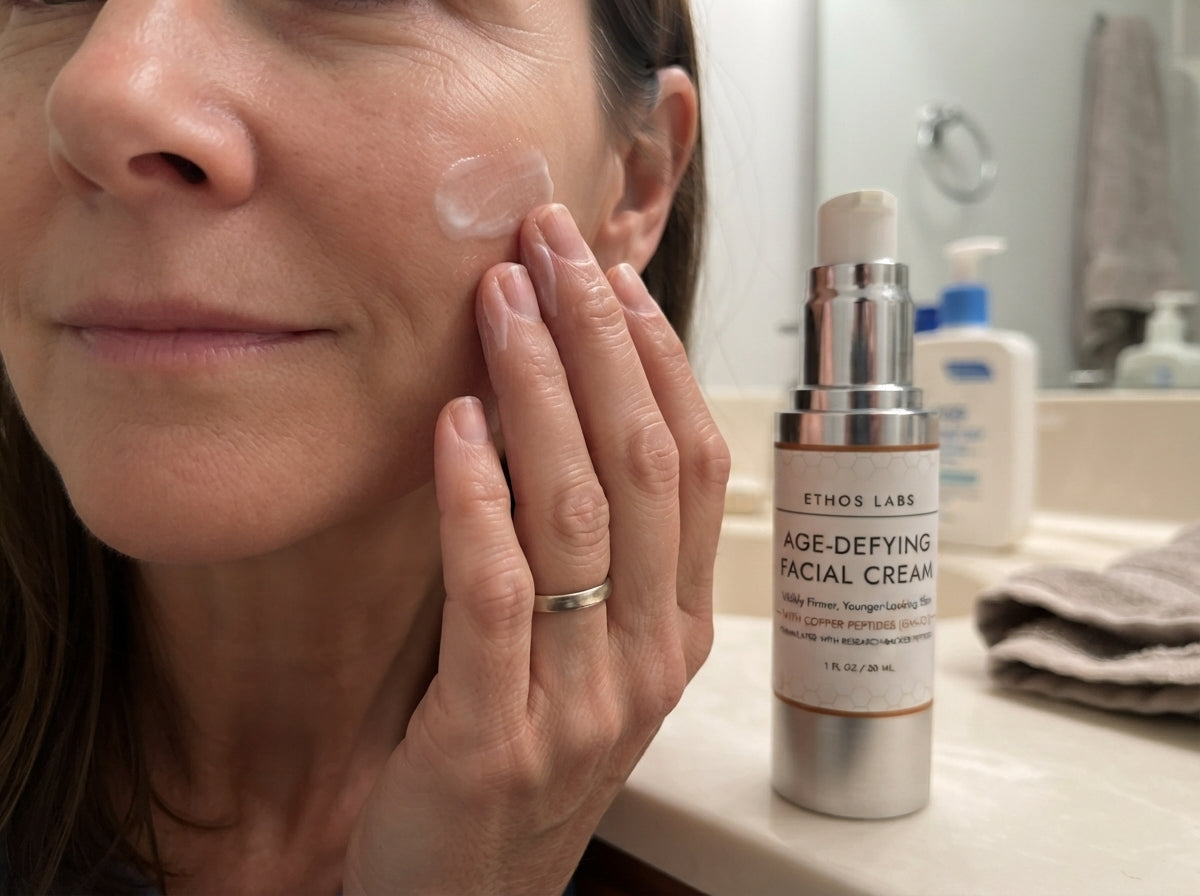
The part that surprised me is that my routine got shorter, not longer.
The vitamin C serum dropped out. I'd been layering that underneath before, and I read somewhere that you don't want to double up on those two, so I stopped.
One thing in the morning, one at night. That's the whole routine now.
It's lighter than I expected. A thin lotion rather than a thick cream. It absorbs in about thirty seconds and it isn't sticky or greasy afterwards.
No scent either, which I like. I don't want to smell my skincare all day.
One pump does my whole face. It sits fine under makeup as long as I actually wait for it to absorb. If I rush it and go straight to foundation I do get a little pilling, but that's on me for not waiting.
Two Things I'd Warn You About
Two things, honestly.
The pump gives you more than I actually need, so I end up wasting a little every time unless I catch myself before pressing all the way down.
And in the middle of winter here it isn't quite enough on its own. My skin still gets a little tight if I don't add a heavier moisturizer over it at night.
I don't think that's a flaw exactly. I just don't think it's meant to be the only thing on your face in a Midwest February.
If a retinoid is working for you and your skin tolerates it, stay on it. You don't have a problem to solve.
And if you're expecting to look thirty again, this isn't that, and I'd be annoyed at anyone who told you otherwise.
But if you're like I was, if you've quit two or three things because your face couldn't take them, and you've decided the problem is you, this is the thing I'd look at next.
If You've Already Quit Three Things, I Was You
I'd say I was you.
I quit on things too, and I don't think that means you did anything wrong. Most of what's out there genuinely doesn't do much.
I'd just say give this one the full two months before you decide. For me nothing happened until past a month in, and if I'd quit at three weeks the way I nearly did, I would have missed it entirely.
On the price, I thought $42 was too much too. Especially after wasting money on things that did nothing.
What changed my mind was realizing I'd already spent more than that on products that didn't work. So it was never really about the number. It was about whether it worked. Once it did, the price stopped bothering me.
If a friend my age asked me straight out whether it's worth it, I'd say yes, but only if you're willing to give it two months, not two weeks. If you're the type to quit after one bottle, save your money.
And the one thing I would warn you about: it is not instant.
If you're expecting a difference in a week, the way some ads make it sound, you'll be disappointed and you'll probably quit before it does anything.
It took me over a month. That's the honest timeline, not the fast one.
I also expected the fine lines to just disappear, if I'm honest, probably from the ad language. They didn't. They're softer, and that's a different thing. I'd rather you know that going in than feel let down later.
If I could change one thing about how this was sold to me, it would be the timeline.
If the ad had just said upfront that it takes about a month to see anything, I wouldn't have almost quit at week three. I went in expecting faster, because that's how most ads talk.
Finding out the real timeline afterwards felt almost like a bait and switch, even though nobody lied to me exactly.
So I'd rather you hear it from me now. About a month. Give it two.
60-day money-back guarantee
| Ethos Labs | Retinoids | Vitamin C serums | Luxury creams | |
|---|---|---|---|---|
| Works without irritation | ✓ | ✕ | ✓ | ✓ |
| Stable in the bottle | ✓ | ✓ | ✕ | ✓ |
| Molecule the body already makes | ✓ | ✕ | ✕ | ✕ |
| Decades of published research | ✓ | ✓ | ✓ | ✕ |
| Fragrance-free | ✓ | ✕ | ✕ | ✕ |
| Under $45 a month | ✓ | ✓ | ✕ | ✕ |
Based on ingredient class, not on head-to-head testing of specific products.
Where Can I Buy Ethos Labs Age-Defying Facial Cream?
Denise's account is one customer's experience. Here is what is actually in the bottle, what it costs, and what it does not do.
The active ingredient is GHK-Cu, a copper peptide. It is not a new discovery and it is not a proprietary blend invented for marketing. It occurs naturally in human blood plasma and was first identified there in 1973.
Most anti-aging ingredients work by acting on the skin from the outside. Retinoids drive cell turnover through controlled irritation, which is why the peeling and redness happen and why a meaningful share of people stop using them. L-ascorbic acid degrades on contact with air and light, which is why a fresh vitamin C serum is nearly clear and an older one has gone amber.
GHK-Cu is a signal peptide. Published laboratory research has examined its role in skin remodeling, including work on collagen and on the structural material around it. The amount your body carries declines substantially with age.
We want to be precise about what that evidence is. It is laboratory research on the ingredient across five decades. It is not a clinical trial of this finished cream, and any brand telling you otherwise is overstating it. The three primary papers are cited at the bottom of this page so you can read them yourself.
Each bottle is 1 fl oz / 30 ml of a lightweight daily cream, dosed at a concentration that reflects the research rather than a trace amount added so the word “peptide” can appear on the label.
What is not in it: no retinol, no acids, no fragrance. That is deliberate. Fragrance is one of the most common causes of irritation in skincare, and the entire point of this formula is that it does not work by irritating you.
There is no adjustment period to survive, because there is nothing to adjust to. It is a molecule your body already produces.
It ships in an airless pump bottle rather than a jar. That matters more than it sounds: a jar exposes the formula to air and to your fingers every single day. The pump keeps the product sealed until the moment it comes out.
It goes on clean skin, morning and night. It can be used on the face, and extended to the neck and chest if you want to.
It layers under sunscreen and under makeup. It is one step, not a system.
For most people it replaces a serum, a moisturizer and a separate treatment product, which is why Denise's routine got shorter rather than longer. Cleanse, apply, sunscreen. About three minutes.
A single bottle used twice daily is roughly a one month supply.
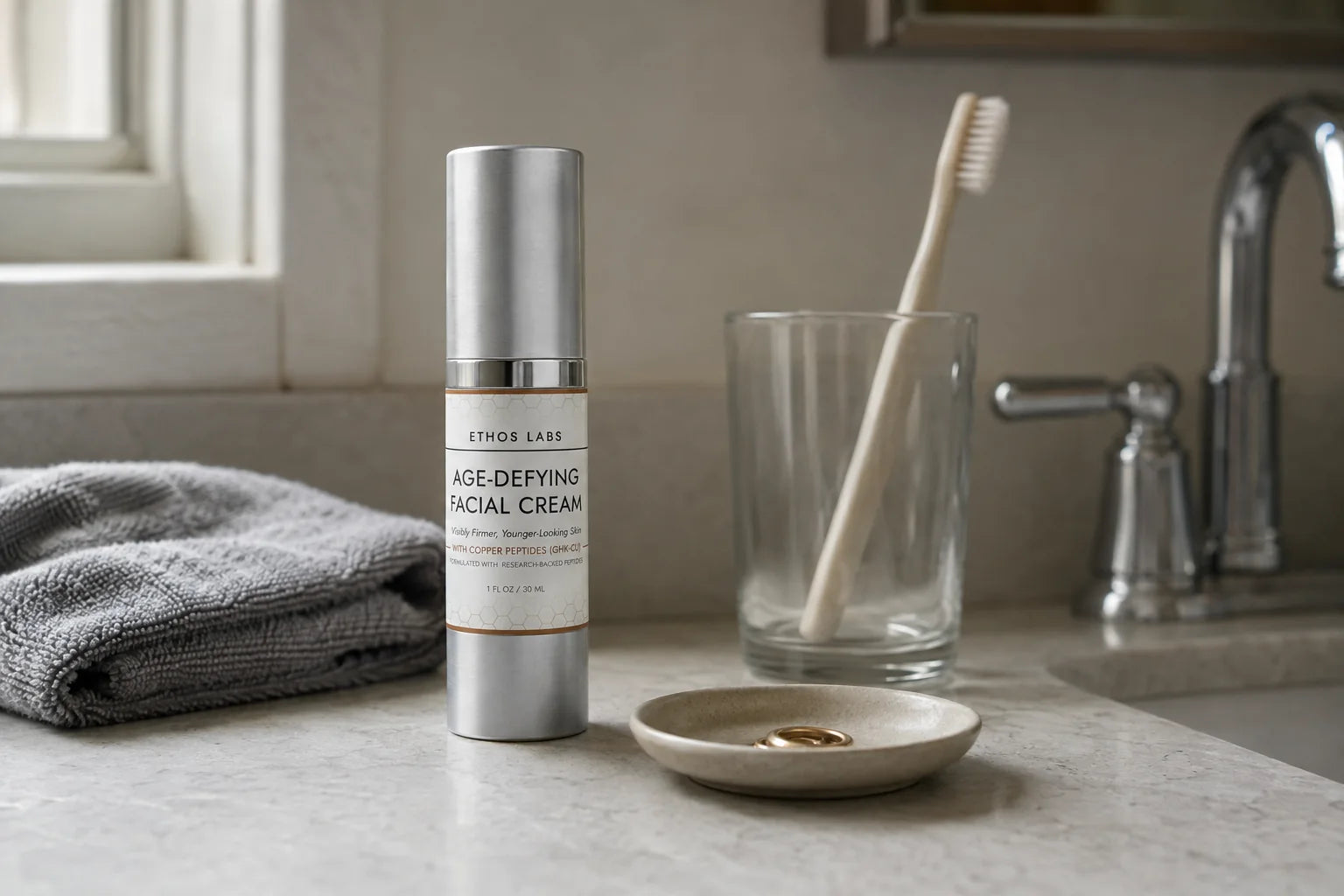
A single bottle is $54. On a subscription it is $42 a bottle. On the 90-day supply it works out to $37 a bottle, against a regular price of $89.
At $37 that is roughly $1.25 a day for the one step we would want someone doing anyway.
It is worth putting that against what the category normally asks. A department store anti-aging set runs $150 to $300 and buys you six to eight weeks. In-office treatments run into the thousands and require repeat visits.
What explains those numbers is rarely the formula. It is retail margin, department store counters, celebrity endorsements and packaging designed to justify the price on it. Ethos Labs sells directly. The product arrives in a plain airless pump bottle. There is no counter, no spokesperson, and no box inside a box.
Denise put it more plainly than we can: she had already spent more than $270 on products that did nothing, so the question was never the price. It was whether it worked.
What arrives. A 1 fl oz airless pump bottle, shipped from the United States. Orders of two or more bottles ship free.
The subscription. If you choose a subscription it renews automatically at the same price, and you can cancel it at any time by replying to your order email or from your account. There is no phone call and no retention script.
The guarantee. Every order is covered for 60 days. Use the entire bottle. If your skin does not look and feel noticeably better, reply to your order email and you are refunded in full. There is nothing to ship back.
Sixty days is deliberate. Skin remodels over months, not days. Fourteen days would not be long enough for anyone to know, and Denise nearly quit at week three, before anything had happened.
What we will not tell you. That this will give you the face you had at thirty. It will not, and no topical will. If your main concern is deep static lines that are visible when your face is completely at rest, that is an injectable conversation and we would rather say so than take your money.
60-Day Money-Back Guarantee
This is the part that got me over the line, so I'll say how it works.
You use the bottle. If your skin doesn't look and feel better, you reply to your order email and you're refunded. There's nothing to ship back.
Sixty days is about right, too. Nothing meaningful happened to me in the first month. If they'd given me fourteen days I'd have asked for my money back before anything started.
60-day money-back guarantee · Free shipping on 2+ bottles
How Much Longer Will You Keep Buying Things That Do Not Work?
The real cost of this category is not any single purchase. It is the pattern.
It is the $25 retinol you stopped using after two weeks. The $65 serum you finished out of stubbornness. The $180 set that smelled expensive and changed nothing. Most women over fifty have several hundred dollars of that history in a bathroom drawer right now.
And the more expensive part is not the money. It is the four months you spend on each one before you admit it is not working, and the quiet conclusion you draw afterward that the problem must be your skin.
Ethos Labs is a new company and this is the first production run. The launch pricing above holds while that run lasts. After it, the price goes up. That is not a countdown clock invented to rush you. It is simply where a new brand starts and where it ends up once it is no longer new.
60-day money-back guarantee · Free shipping on 2+ bottles
What Do Others Have To Say About Ethos Labs Age-Defying Facial Cream?
Reviews are published as customers submit them. Names and photographs appear only with written permission.
Brightens skin and fades age spots ★★★★★
Patricia M. | Verified Buyer
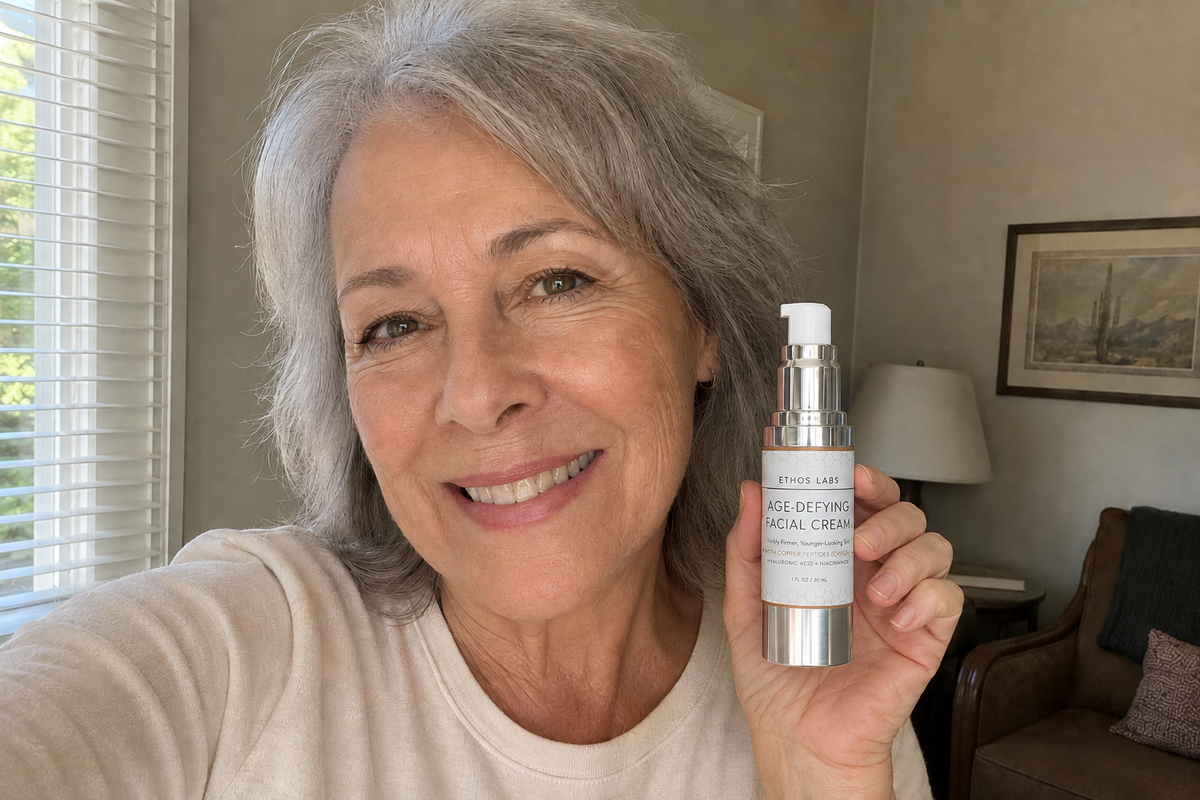
After just a day or two my skin appeared much brighter and healthier. I had a brown spot under my left eye which is almost gone now after only using for a month.
Loving this little bottle ★★★★★
Brenda T. | Verified Buyer
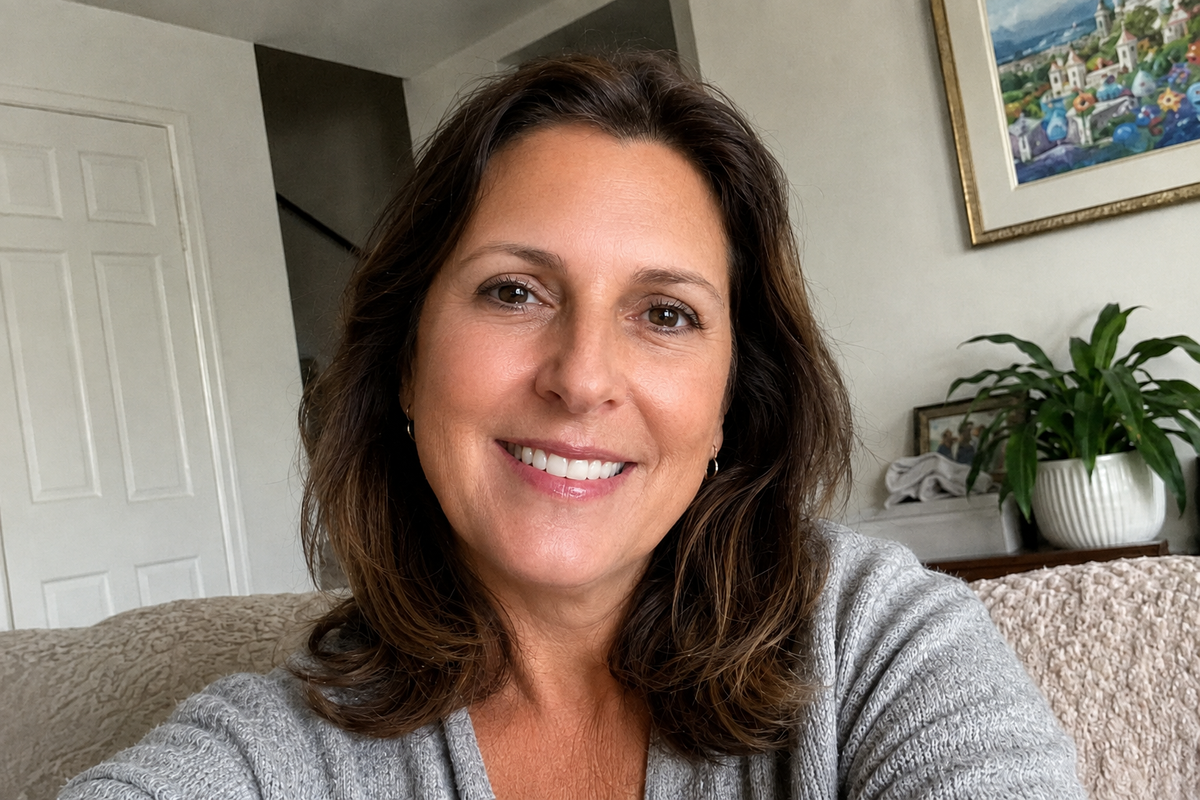
It has been great watching my face transform. The wrinkles and crow's feet look like they are disappearing. My whole face looks more even and tighter.
Great product! ★★★★★
Carol W. | Verified Buyer
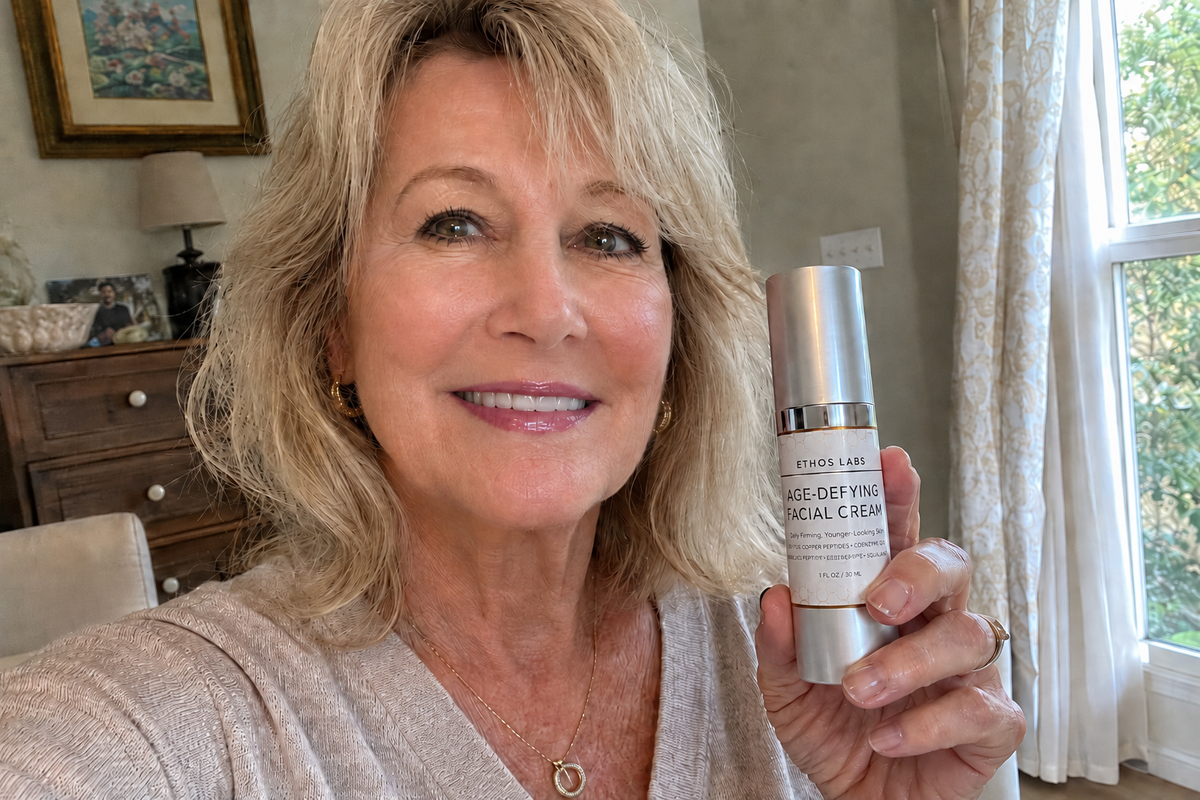
I just moved from Georgia to Arizona and cannot believe how hard the dry air is on my skin. After trying Ethos Copper Peptide Cream for over 3 weeks, I can't believe how it has made a real difference. My face feels and looks like someone has turned the clock back. I am 68 years old and have tried them all. Getting ready to order my 2nd bottle, so pleased to find this product.
Launch pricing while the first production run lasts
Using Just One Product Designed For Skin Over 50, You Can Simplify Your Whole Routine
One bottle, twice a day, on clean skin. That is the entire routine.
It replaces a serum, a moisturizer and a separate treatment product. No retinol, no acids, no fragrance, and no adjustment period to survive, because GHK-Cu is a molecule your body already produces rather than something applied to force a reaction.
On the 90-day supply it works out to $37 a bottle, roughly $1.25 a day, against the $150 to $300 a department store set asks for six to eight weeks of product.
Every order is covered for 60 days. Use the whole bottle. If your skin does not look and feel noticeably better, reply to your order email and you are refunded in full. Nothing to ship back.
Launch pricing holds while the first production run lasts.
Current offer
Launch pricing, while the first production run lasts
Subscription starts at $42 a bottle. The 90-day supply works out to $37 a bottle, down from $89, with free shipping every time.
Every order is covered by a 60-day money-back guarantee. Use the whole bottle. If your skin doesn't look and feel better, reply to your order email and you'll be refunded in full.
60-day money-back guarantee · Cancel anytime

I’ve been using the Ethos Age-Defying Facial Cream for almost three weeks. I really like the texture - it feels rich but absorbs quickly and doesn’t leave my face greasy. My skin feels softer, and the area around my eyes looks more refreshed.

I bought this because I wanted to try copper peptides without adding another complicated step to my routine. I use one pump after cleansing, and it leaves my skin feeling comfortable and moisturized. After about a month, my complexion looks brighter and more even.

I’m 66 and have tried a lot of anti-aging creams. This is one of the few that feels moisturizing without sitting heavily on my skin. The fine lines around my mouth seem softer, and my face has a healthier, more rested appearance.

I am pleased so far. I received this product several months ago and started using it 2-3 weeks ago. I like the texture and how nicely my skin absorbs the cream. I have noted an improved vibrancy and healthy look overall.


The pump bottle makes it easy to use the same amount every morning and evening. After several weeks, my skin feels smoother and a little firmer, especially around my cheeks and jawline. My sister even asked whether I had changed something in my routine.

I have been using this product for over a few weeks and I'm already seeing improvement in the smile lines around my mouth. I've also noticed the small lines around my eyes have also improved.
60-day money-back guarantee · Free shipping on 2+ bottles
References
- Pickart L, Thaler MM. “Tripeptide in human serum which prolongs survival of normal liver cells and stimulates growth in neoplastic liver.” Nature New Biology. 1973;243(124):85–87. PMID: 4349963.
- Schlesinger DH, Pickart L, Thaler MM. “Growth-modulating serum tripeptide is glycyl-histidyl-lysine.” Experientia. 1977;33:324–325.
- Pickart L, Margolina A. “Regenerative and protective actions of the GHK-Cu peptide.” International Journal of Molecular Sciences. 2018;19(7):1987.
This is an advertisement. Denise M. is an Ethos Labs customer who purchased the product herself and received no compensation for this article. Her experience is her own and is not a guarantee of results. Individual results vary.
These statements have not been evaluated by the Food and Drug Administration. This product is not intended to diagnose, treat, cure or prevent any disease.
Comments